How to stop overthinking about a relationship, starting with the message you just re-read
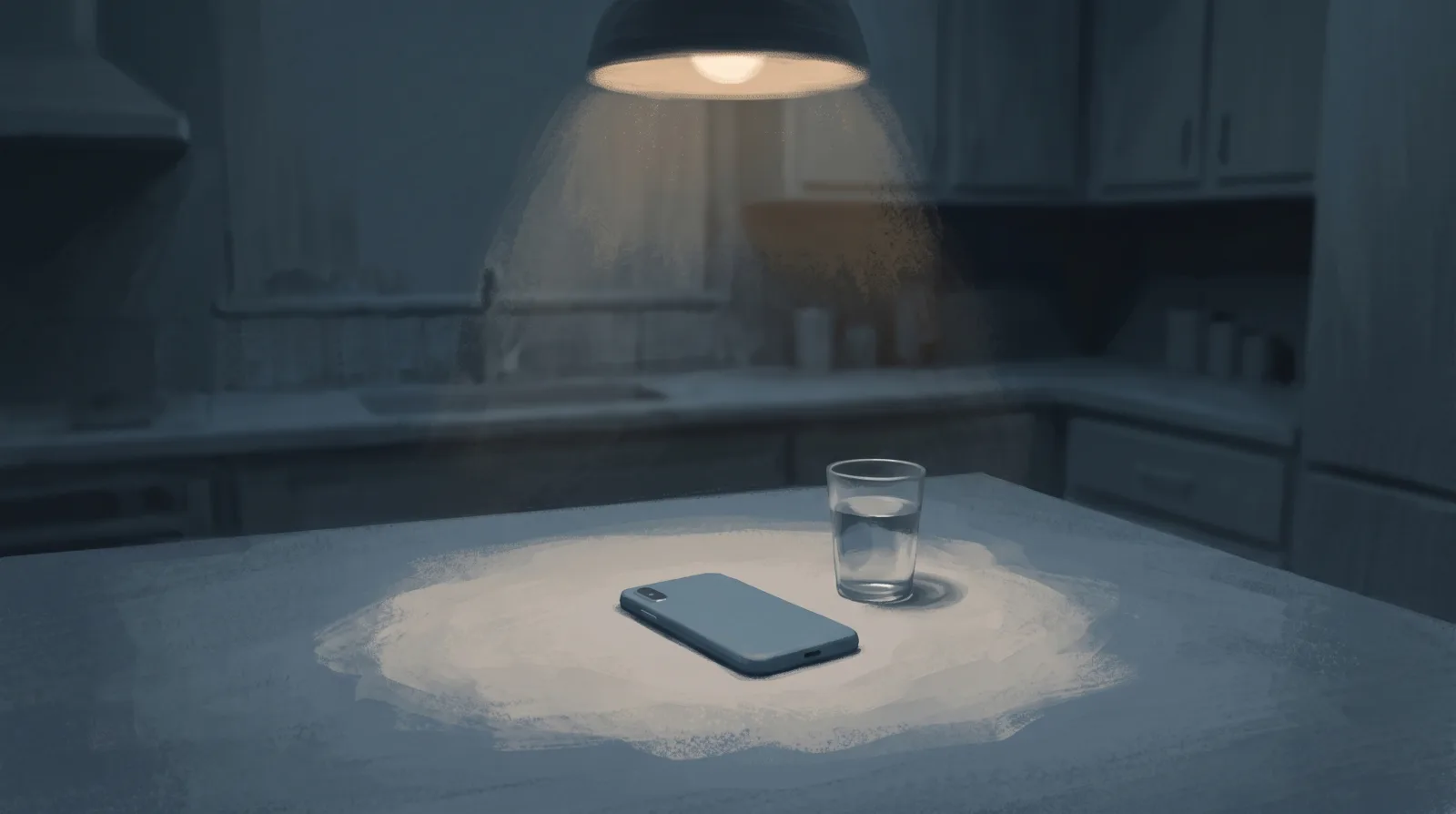
You are looking for how to stop overthinking about a relationship because you have been doing it for the last forty minutes, on your phone, in a room where nothing else is happening. This page starts with what you can do right now, not with theory.
The direct answer
Close the thread. Not forever, just for now, and not because the answer is in there — because it isn't. The thing you are doing when you re-read a message is not analysis. It feels like analysis. It has the posture of analysis: careful attention, weighing of words, consideration of tone. But you are not finding new information. You are running the same six sentences through your head for the ninth time, hoping the tenth pass produces a different result.
It won't. The words don't change. What changes is you, a little, each time — more convinced there's something in there to find, less sure of your own read on the situation. The most direct thing you can do is put the phone down somewhere you can't see it and do one physical, boring task: dishes, a walk, folding something. Not as a distraction technique. As a way of letting your body confirm what your head won't: nothing is happening right now. You are safe and idle. The message will still be there in an hour.
What you're calling thinking is actually checking
Overthinking a relationship rarely feels like worry. It feels like diligence. You're not panicking, you're being careful — checking her tone, checking the gap between replies, checking whether 'k' means something different from 'okay.' It has the shape of a person solving a problem.
But a problem has an endpoint. Checking doesn't. You can reread a four-word text fifteen times and end each pass no closer to certainty than the first, because certainty was never available from the text. It was available, maybe, from a conversation you haven't had. The checking is a stand-in for that conversation — a way of doing something that isn't asking the actual question out loud.
The two-hour reply and what your brain does with the gap
Someone takes two hours to reply and your mind fills that gap with a story, because a gap with no story in it is unbearable to sit inside. The story is usually about you: what you did, what you shouldn't have said, whether you're too much. It rarely occurs to you that they were in a meeting, or asleep, or just didn't feel like typing yet.
This isn't a flaw in your reasoning. It's what a mind does when it doesn't have the information it wants and can't stand the wait. It writes something. Anything, so long as it's a shape rather than a blank. The trouble is you then react to the shape as if it were fact — you get quieter, or you send something testing, or you decide something about the relationship based on a story you wrote in the two hours you were waiting for a text.
Why replaying the conversation doesn't tell you anything new
You go back over what was said — the exact phrasing, who paused, who looked away — as if enough replays will finally surface the true meaning. But a conversation isn't a puzzle with a hidden solution. Most of what happens between two people is ordinary and half-formed: tired words, an offhand comment, a joke that landed wrong for no deep reason.
When you replay it looking for meaning, you tend to find whatever you were afraid of before you started looking. That's not evidence. That's the shape of your worry, projected back onto a memory that can't defend itself. The tenth replay isn't more accurate than the first. It's just more tired.
The 2am version of this
At 2am the loop gets louder because there's nothing else competing for your attention — no work, no conversation, no noise to drown it out. So the same three questions circle: does she still want this, did I say too much, what did that pause mean. Lying still makes it worse, not better, because stillness gives the loop the whole room.
If this is where you are most nights, it's worth naming plainly: this isn't you thinking clearly about your relationship. It's your mind, unoccupied, doing the only thing it has left to do. Getting up, even for five minutes — water, a window, a different room — sometimes breaks the loop's grip more than trying to reason your way out of it while still lying in the dark.
What actually needs to happen instead
At some point the checking has to be replaced by a conversation, or by a decision to let the question go unanswered for a while. Neither of those happens inside your own head, no matter how many times you turn the evidence over. If something needs saying — that you're anxious, that a particular silence unsettled you — it needs to be said to the person, not resolved alone at your kitchen table at midnight.
And if it can't be said yet, or the moment isn't right, the honest option is to notice the loop starting and choose, on purpose, to stop feeding it — not because you've solved it, but because you've recognised what it is. That recognition, oddly, is the part that tends to take practice. Not the stopping. The noticing.
Questions people ask next
- Is overthinking a relationship a sign it's the wrong one?
- Not necessarily. It can happen in relationships that are fine and relationships that aren't — the loop responds more to uncertainty and waiting than to whether the relationship itself is good. It tells you more about how you handle unclear moments than about the relationship's quality.
- Why do I only overthink at night?
- During the day there's usually enough happening — work, people, tasks — to keep the loop from taking over fully. At night, with nothing competing for attention, the same three or four questions get the whole room to themselves and start to feel louder and more urgent than they actually are.
- Should I just ask them what they meant?
- Often, yes — a plain question usually settles more than another hour of rereading ever will. The hesitation to ask is usually less about the answer and more about what asking might reveal, which is worth noticing on its own.
- What if I've asked and I still can't stop replaying it?
- Then the loop has probably stopped being about the actual answer. It's become a habit the mind runs regardless of new information. At that point the more useful question isn't 'what did they mean' but 'what am I doing right now instead of just sitting with not knowing.'